Call : +1 878-867-9576
Whatsapp : +1-833-388-3090
Email : info@creativeworldprime.com
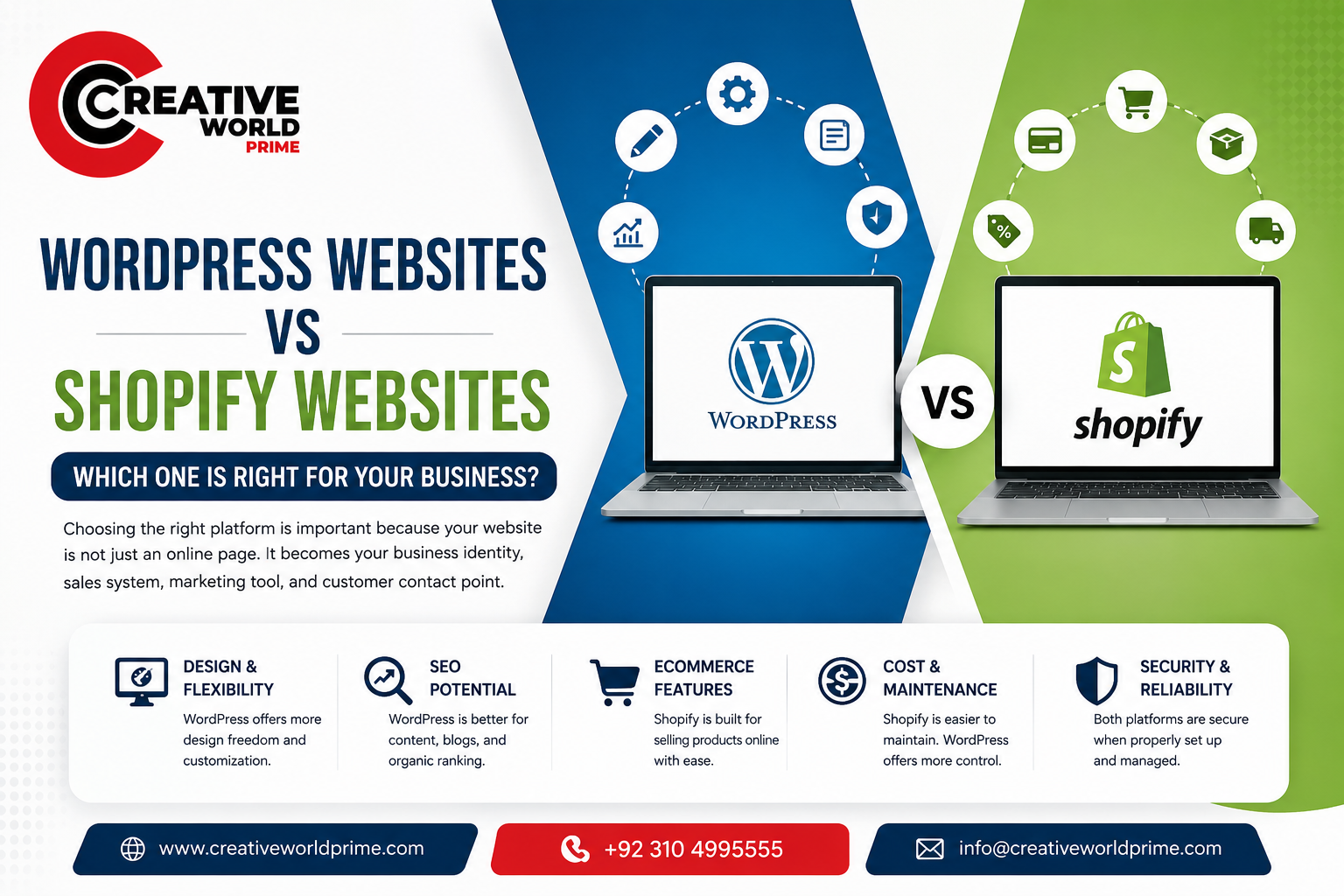
Many business owners get confused when choosing between WordPress websites and a Shopify website. Both platforms are popular, but they are not built for the same purpose. WordPress is known for flexibility, content, and customization, while Shopify is mainly designed for selling products online.
Choosing the right platform is important because your website is not just an online page. It becomes your business identity, sales system, marketing tool, and customer contact point. If you choose the wrong platform, you may face problems later with design, SEO, speed, cost, or management.
The better choice depends on your business type, goals, budget, and long-term plan. If you are running a service-based business, WordPress may be more useful. If you want to create an online store and sell products, Shopify may be the better option.
Let’s compare both platforms in a simple and practical way.
1. What Are WordPress Websites?
WordPress websites are built using WordPress, one of the most widely used website platforms in the world. It is commonly used for business websites, blogs, portfolios, service pages, landing pages, educational websites, and even online stores.
The biggest strength of WordPress is flexibility. You can build almost any type of website with it. Whether you need a company website, agency website, blog website, booking website, or custom business website, WordPress gives you many options.
A WordPress website usually needs:
- Domain name
- Web hosting
- Theme
- Plugins
- Security setup
- Speed optimization
- SEO settings
WordPress gives more control over website development, but it also needs proper setup and maintenance.
2. What Is a Shopify Website?
A Shopify website is mainly built for eCommerce. It helps businesses create online stores where they can sell products, manage orders, accept payments, and handle inventory.
Shopify is popular because it makes online selling easier. Business owners do not need to manage hosting, checkout security, or complicated technical settings. Most of these features are already included in Shopify.
A Shopify website is useful for:
- Fashion stores
- Beauty product stores
- Electronics shops
- Handmade product businesses
- Dropshipping stores
- Digital product stores
- Retail brands
- Online product-based businesses
If your main goal is to sell products online, Shopify can be a simple and reliable choice.
3. Ease of Use
Shopify is easier for beginners. Its dashboard is simple, and you can add products, manage orders, check payments, and update your store without needing advanced technical knowledge.
WordPress is also user-friendly, but it requires more setup in the beginning. You need hosting, theme installation, plugin setup, security, and speed optimization. Once the website is professionally developed, managing content and pages becomes easier.
For a person who wants a ready eCommerce system, Shopify is easier. For someone who wants more control and flexibility, WordPress is better.
4. Design and Customization
Website designing is important for both platforms because the design affects user trust, experience, and conversions.
WordPress offers more design freedom. You can create custom layouts, service pages, blog sections, landing pages, portfolio pages, membership sections, and many other features. It is suitable for businesses that want a unique and fully customized website.
Shopify also provides professional themes and design options, especially for online stores. You can customize homepage sections, product pages, collection pages, and checkout-related areas. However, deep customization may require Shopify development skills.
If your focus is complete design control, WordPress websites are usually better. If your focus is a clean product-selling website, Shopify is a strong option.
5. SEO Potential
SEO is one of the biggest reasons many businesses prefer WordPress. WordPress websites are very useful for content marketing, blogs, service pages, landing pages, internal linking, and search engine optimization.
With WordPress, you can create:
- SEO-friendly blog posts
- Service pages
- Location-based pages
- FAQs
- Landing pages
- Optimized URLs
- Internal links
- Meta titles and descriptions
Shopify also supports SEO, especially for product pages and collection pages. You can optimize product titles, product descriptions, image alt text, and meta descriptions.
However, if your business depends heavily on blogs, service pages, and organic ranking, WordPress usually gives more SEO flexibility. If your focus is product-based SEO, Shopify can also perform well with proper optimization.
6. eCommerce Features
Shopify is built specifically for online selling. It already includes many eCommerce features such as product management, secure checkout, payment options, discount codes, shipping settings, inventory tracking, and order management.
WordPress can also support eCommerce through WooCommerce. This gives more flexibility, but it also requires more setup, plugins, and maintenance.
For a simple and smooth online store, Shopify is often the better choice. For a highly customized online store with special features, WordPress with WooCommerce can also be powerful.
7. Cost and Maintenance
The cost of both platforms depends on your business needs.
Shopify usually has a monthly plan. You may also need paid themes or apps depending on the features you want. The benefit is that hosting, checkout, and basic security are managed by Shopify.
WordPress itself is free, but you need to pay for hosting, domain, premium themes, plugins, security tools, and maintenance if required. It can be affordable or expensive depending on how your website is built.
Shopify is easier to maintain because many technical things are handled by the platform. WordPress gives more control, but it needs regular updates, backups, plugin management, and security checks.
8. Blogging and Content Marketing
WordPress is much stronger for blogging and content marketing. If your goal is to rank your website through useful articles, service guides, industry blogs, and SEO content, WordPress websites are a better option.
For example, a website development company can publish blogs about website designing, Shopify website benefits, WordPress SEO, and online business growth. This type of content can help attract visitors from Google.
Shopify also has a blog feature, but it is not as advanced as WordPress. Shopify is more product-focused, while WordPress is more content-focused.
9. Security
Shopify manages security, hosting, and checkout protection for store owners. This makes it easier for businesses that do not want to handle technical security tasks.
WordPress security depends on how the website is developed and maintained. A secure WordPress website should include:
- SSL certificate
- Updated plugins
- Reliable hosting
- Strong passwords
- Security plugin
- Regular backups
- Malware protection
Both platforms can be secure, but Shopify requires less manual security work. WordPress can also be very secure if it is professionally managed.
10. Which Platform Should You Choose?
Choose WordPress websites if you need:
- A service-based business website
- Strong blogging and SEO
- Full design flexibility
- Custom website features
- Portfolio or agency website
- Long-term content marketing
- Better control over structure
Choose a Shopify website if you need:
- An online store
- Easy product management
- Secure checkout
- Simple order handling
- Fast eCommerce setup
- Built-in selling tools
- Less technical maintenance
Both platforms are useful, but they serve different purposes. The right decision depends on what you want your website to do.
Which Option Makes More Sense?
WordPress and Shopify are both powerful platforms, but the right choice depends on your business goal. If your main focus is content, services, SEO, blogs, and long-term flexibility, WordPress is usually a strong option. If your main focus is selling products online with simple store management, Shopify can be a better fit.
Before choosing a platform, think about your products, services, budget, growth plan, and how much control you want over your website. A successful website is not only built on the platform. It is built on clear planning, professional website designing, fast performance, useful content, and a smooth user experience.