Call : +1 878-867-9576
Whatsapp : +1-833-388-3090
Email : info@creativeworldprime.com
Is your website actually bringing customers, or is it just sitting online like a digital brochure? Many businesses have a website, but not every website helps the business grow. A good website should do more than display your company name and services. It should attract visitors, explain your value, build trust, and guide people toward taking action.
This is why professional website development and website designing are so important. A high-converting website is planned carefully. It has the right structure, clean design, fast loading speed, useful content, and a smooth user experience. Whether you are creating custom websites or professional WordPress websites, every section should have a clear purpose.
Below is a step-by-step guide to creating a business website that looks professional and performs well.
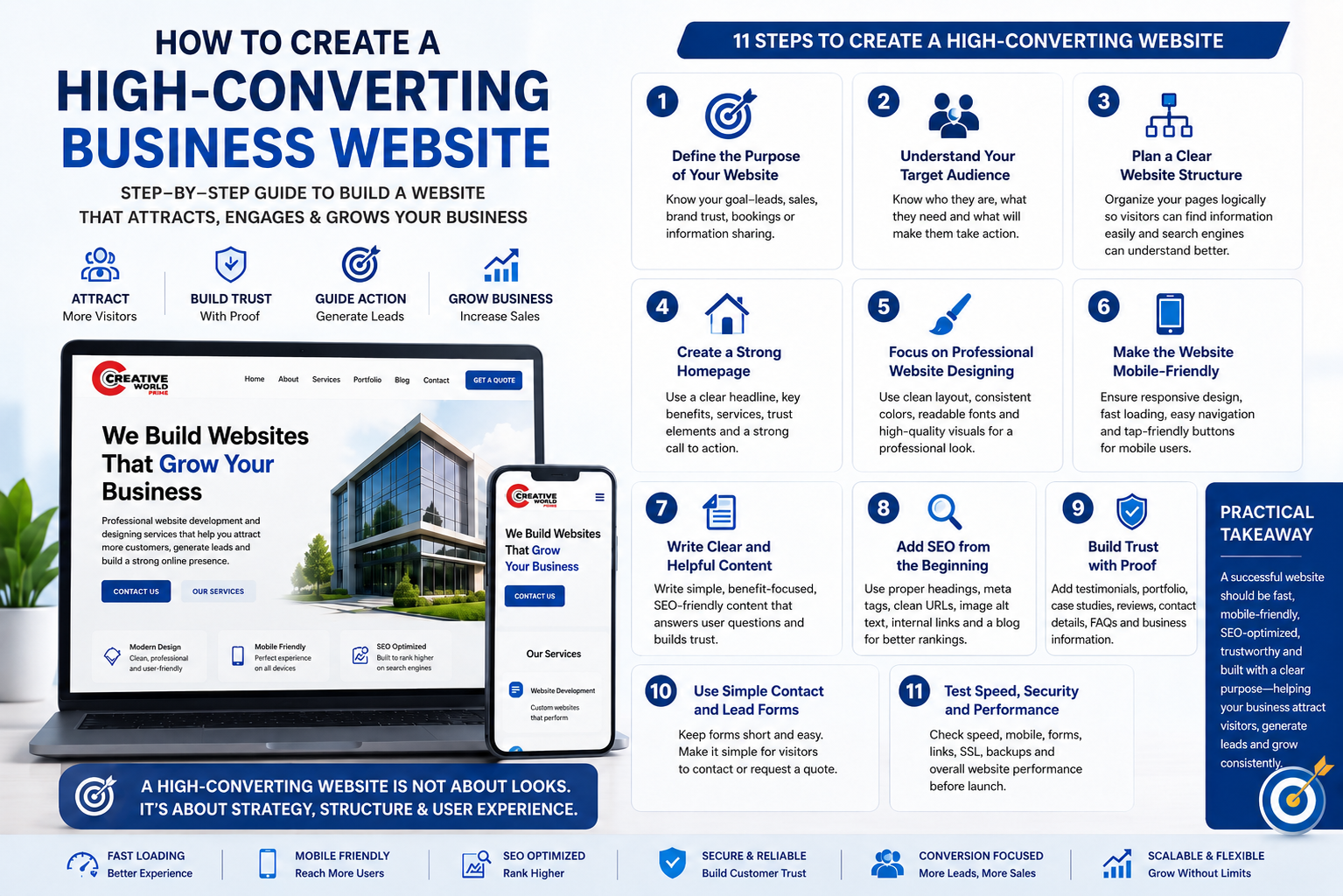
1. Define the Purpose of Your Website
Before starting website development, you need to understand the main purpose of your website. Different businesses need different types of websites.
Your website goal may be:
- Getting more leads
- Selling products online
- Showcasing services
- Building brand trust
- Collecting appointment bookings
- Sharing blogs and information
- Creating a portfolio
If the goal is not clear, the design will also become confusing. For example, a service-based business needs clear service pages and contact forms. An eCommerce business needs product pages, cart, checkout, and payment options. A portfolio website needs project examples and visual proof.
A website should be built around your business goal, not just around design trends.
2. Understand Your Target Audience
A high-converting website speaks directly to the right people. Before designing pages, you should understand who your visitors are and what they need.
Ask simple questions:
- Who will visit this website?
- What problem are they trying to solve?
- What information do they need first?
- What will make them trust the business?
- What action should they take after visiting?
If your audience is business owners, your content should be professional and benefit-focused. If your audience is general customers, the language should be simple and clear. Good website designing is not only about colors and layout; it is also about understanding user behavior.
3. Plan a Clear Website Structure
Website structure is one of the most important parts of website development. If visitors cannot find information easily, they will leave.
A basic business website may include:
- Home page
- About page
- Services page
- Individual service pages
- Portfolio or case studies
- Blog section
- Contact page
- FAQ section
For WordPress websites, this structure is easy to manage and expand over time. You can add new service pages, publish blog posts, and improve SEO gradually.
A clear structure also helps search engines understand your website better. When your pages are properly organized, it becomes easier to rank for relevant keywords.
4. Create a Strong Homepage
Your homepage is usually the first page visitors see. It should quickly explain who you are, what you offer, and why someone should trust your business.
A strong homepage should include:
- Clear headline
- Short explanation of your service
- Key benefits
- Main services
- Trust elements
- Testimonials
- Contact option
- Simple navigation
Do not overload the homepage with too much information. The goal is to guide visitors toward the most important sections of your website.
A good homepage works like a summary of your business. It should make people interested enough to explore more.
5. Focus on Professional Website Designing
Design creates the first impression. If your website looks outdated or messy, visitors may not trust your business. Professional website designing helps your brand look serious, modern, and reliable.
A good website design should have:
- Clean layout
- Consistent colors
- Easy-to-read fonts
- Proper spacing
- High-quality images
- Clear buttons
- Mobile-friendly sections
- Balanced visual style
Design should not distract users. It should support the content and make the website easier to use. A simple, clean, and professional design usually performs better than a website full of unnecessary effects.
6. Make the Website Mobile-Friendly
Most people browse websites from mobile phones. If your website does not work properly on mobile, you can lose many visitors and potential customers.
A mobile-friendly website should have:
- Responsive layout
- Fast loading speed
- Easy navigation
- Readable text
- Proper image sizing
- Tap-friendly buttons
- Simple forms
Mobile users usually want quick answers. They should be able to understand your services, view your work, and contact you without difficulty.
For WordPress websites, using a responsive theme and optimized layout is very important.
7. Write Clear and Helpful Content
Content plays a major role in website success. Visitors should quickly understand what you offer and how your service can help them.
Good website content should be:
- Simple
- Clear
- Benefit-focused
- SEO-friendly
- Easy to scan
- Written for real users
Avoid writing only about yourself. Instead of saying, “We are the best company,” explain how your services solve customer problems.
For example, instead of writing:
“We provide website development services.”
A better version would be:
“We build professional websites that help businesses attract visitors, generate leads, and create a strong online presence.”
This type of content sounds more useful and customer-focused.
8. Add SEO from the Beginning
SEO should not be added after the website is finished. It should be part of the planning and development process.
SEO-friendly website development includes:
- Proper heading structure
- Optimized page titles
- Meta descriptions
- Clean URLs
- Image alt text
- Internal links
- Fast loading speed
- Mobile-friendly design
- Blog section
- Keyword-focused service pages
If you want your website to rank on Google, you need proper SEO structure from the start. WordPress websites are especially useful for SEO because they allow easy blog publishing, page optimization, and content updates.
9. Build Trust with Proof
People do not trust a business just because it has a website. They need proof. Trust-building elements can increase confidence and improve conversions.
You can add:
- Client testimonials
- Project portfolio
- Before and after examples
- Case studies
- Business address
- Contact number
- Social media links
- Certifications
- Reviews
- FAQs
These elements show that your business is real and experienced. A website with proof feels more reliable than a website with only claims.
10. Use Simple Contact and Lead Forms
A high-converting website should make it easy for people to contact you. If your form is too long or confusing, visitors may not complete it.
A good contact form may include:
- Name
- Phone number
- Service required
- Message box
For service businesses, you can also add quote request forms or appointment booking forms. The easier it is to contact you, the better your chances of generating leads.
11. Test Speed, Security, and Performance
Before launching your website, always test performance. A slow or broken website can hurt your business image.
Check these things:
- Page loading speed
- Mobile responsiveness
- Contact forms
- Broken links
- Image quality
- Browser compatibility
- SSL certificate
- Basic security settings
- Backup setup
For WordPress websites, plugin updates, security tools, and backups are very important. A professional website should not only look good; it should also work properly.
Practical Takeaway
Creating a high-converting business website is not about using fancy graphics or random templates. It is about planning each section with a clear purpose. Strong website development gives your site a solid technical base, while professional website designing makes it attractive, easy to use, and trustworthy.
A successful website should explain your business clearly, load quickly, work smoothly on mobile, support SEO, and guide visitors toward the next step. Whether you are building custom websites or WordPress websites, the goal should always be the same: create a website that helps your business grow.
A website is often the first serious interaction between your business and a potential customer. When it is designed properly, it can become one of your strongest online marketing assets.